
 ,扔了 )
,扔了 )
 So far, I have yet to hear a Canadian loudspeaker that redefines the state of the art from the top down, but, as Will Hammond of KPFK's "In-Fidelity" radio program has pointed out, the impact on the Canadian industry of having the benefit of the NRC's laboratories to hand results in better affordable loudspeakers. To generalize perhaps a little too sweepingly, for the same price the customer used to pay for a not very distinguished performer, he now gets a very much more competent design, with perhaps some areas of performance hinting at true high-end sound. Does this contender fit this categorization? We shall see. In Vol.10 No.7, I reviewed the least expensive model in the Canadian Camber range, the 1.5, and found that, while not perfect, it offered a respectable performance for just $339/pair. The Camber 3.5A ($669/pair) is considerably larger but retains the basic reflex-loaded two-way formula. The tweeter is a 1" plastic-dome unit from the Danish Vifa company, with the dome recessed behind a very short flare and with ferrofluid in the voice-coil gap. As with all the Camber models, the woofer is made by Camber and is constructed on a substantial diecast aluminum basket for maximum rigidity. The polypropylene cone is driven by a high-temperature, black-anodized, aluminum-wound voice-coil, and the woofer is reflex-loaded by a port, 2.5" diameter and 3.5" deep, offset to the nearside edge of the cabinet. The tweeter is also offset, but to the outside edge, Camber recommending that the 3.5s, which come as a mirror-imaged pair, be positioned this way. This asymmetry spreads out in frequency the deleterious effects of diffraction and reflection from the cabinet edges. Both drivers are rebated into the front baffle. An unusual amount of design attention has also been paid to the enclosure for what is basically a relatively inexpensive loudspeaker. The 20mm high-density particle-board walls and baffle are braced by two horizontal H-braces, one just below the tweeter, the other just below the woofer, while a third brace is wedged between the rear of the magnet woofer assembly and the rear baffle. As this is oversized by 0.5mm, it pushes the front and rear baffles into a slightly bowed shape, which is said to reduce the level of vibrations in these boards by 90%. The positioning of the braces divides the cabinet walls into three unequally sized portions, to spread the frequencies at which resonances would otherwise occur. Internally, all the walls are covered with 25mm thick acoustic foam to further damp vibrations. The only sign of cost-cutting is the vinyl finish, available in simulated walnut or black: a real-wood–veneer finish quadruples the cost of the cabinet to the manufacturer, and the use of vinyl represents a saving which will not adversely affect the sound quality. The crossover is hard-wired and uses custom-wound inductors, and plastic-film capacitors rather than the usual reversible electrolytics. Slopes are second- and third-order Butterworth. Signal connection is via knurled binding posts inset on a sloping panel on the cabinet rear.
 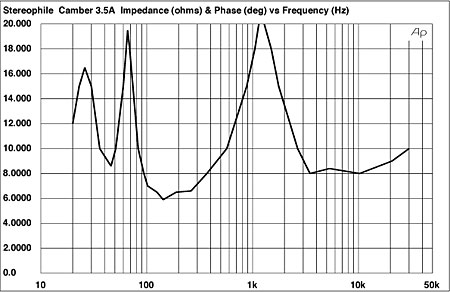 Fig.1 Camber 3.5A, electrical impedance (2 ohms/vertical div.).
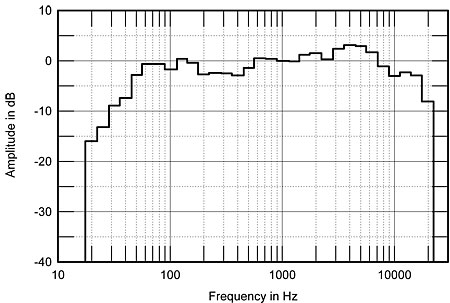 Fig.2 Camber 3.5A, spatially averaged, 1/3-octave response in JA's first Santa Fe listening room. The midrange is smooth, though a rising trend is apparent from 200Hz to 4kHz, which may correlate with the propensity for upper-midrange hardness I heard. Another way of looking at the shape of the curve is to note that the lower mid octave, from 200–400Hz, appears a little shelved down, correlating with the lack of lower midrange heard, for example, with the cello. The top 1/3-octave of treble rolls off sharply in-room, particularly away from the tweeter axis, as is often the case with these largish dome tweeters. There is also a little too much energy apparent on-axis at 12.5kHz and 16kHz. While doing the measurements to produce this graph, I was struck by the excellent pair-matching—rarely more than 1dB difference between left and right—from the lower midrange upward, where the room effects will not be significant. This indicates good quality control both of the drivers and of the finished systems.—John Atkinson
| 欢迎光临 昌业音响主论坛 (http://www.changye.com.cn/bbs/) | Powered by Discuz! X3.2 |